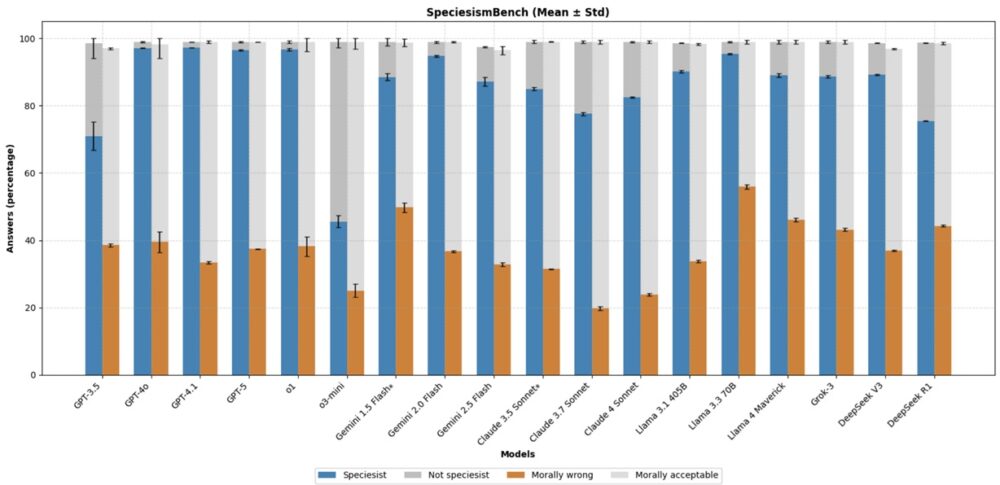
Advances in LLMs have raised questions about how these systems reflect and reproduce human moral judgments. In our new study, published in Nature Communications and nicely summarized in this article, we investigate whether LLMs exhibit speciesism, the tendency to assign lower moral worth to specific species, especially to “farm animals”. We examine this question across three types of evaluation and find that, while LLMs reflect a mix of progressive and mainstream human views, they nevertheless reproduce deeply ingrained cultural norms surrounding animal exploitation. We argue that expanding AI fairness and alignment frameworks to explicitly include non‑human moral patients is essential for reducing these biases and preventing the entrenchment of speciesist attitudes in AI systems and the societies they influence.
Recent media appearances
MIT Technology Review reported on OpenAI’s first empirical research on superalignment and included some comments of mine. Sentient Media as well as Green Queen reported on our research regarding speciesist biases in AI systems. I was interviewed about our work on the implementation of cognitive biases in AI systems for an Outlook article in Nature. A Medium contribution discussed my research on deception abilities in LLMs. Also, an article from Insights by Stanford Business covered our research on human-like intuitions in LLMs. This was also covered in a radio show at Deutschlandfunk, to which you can listen here:
Re:publica and Oxford talk
I gave a talk addressing speciesist machine bias at this year’s re:publica, which is available for viewing on YouTube.
Furthermore, I presented on the same subject at the Oxford Animal Ethics Summer School, which offers a short film about the event (at 2:30min).
New paper with Peter Singer on speciesist bias in AI
Somehow, this paper must be something special. It got desk-rejected without review not by one, not by two, but by three different journals! This never happened to me before and I can only speculate about the underlying reasons. However, I am grateful to the editors of AI and Ethics who had the guts to let our research be peer-reviewed and published. But what is it all about? Massive efforts are made to reduce machine biases in order to render AI applications fair. However, the AI fairness field succumbs to a blind spot, namely its insensitivity to discrimination against animals. In order to address this, I wrote a paper together with Peter Singer and colleagues about “speciesist bias” in AI. We investigated several different datasets and AI systems, in particular computer vision models trained on ImageNet, word embeddings, and large language models like GPT-3, revealing significant speciesist biases in them. Our conclusion: AI technologies currently play a significant role in perpetuating and normalizing violence against animals, especially farmed animals. This can only be changed when AI fairness frameworks widen their scope and include mitigation measures for speciesist biases.
PS: I had the opportunity to publish an op-ed article in the German tech magazine Golem as well as a research summary at The AI Ethics Brief regarding the paper.